'The response to terror is not always reciprocal terror, nor is launching a conventional response the best response.' 'The best response is to make the sponsor pay a price he cannot afford,' says former RA&W chief Vikram Sood.
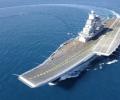
INS Vikramaditya is not the only thing on Defence Minister AK Anthony's agenda during his current visit to Moscow. Also on the anvil is the Fifth Generation Fighter Aircraft joint development project which, if finalised and signed, could emerge as India's largest joint defence programme costing around 11 billion dollars, reports Nandan Unnikrishnan.

Starting as a maker of hydraulic pumps, the Bengaluru-based company graduated to components for automakers like BMW and Audi, and then Airbus and Boeing

'Even in this age of self-willed and authoritarian leaders and spontaneous gestures, a script is still written,' notes Ambassador B S Prakash, imagining the 'talking points' are for the India-US summit on June 26.

Do Modi's foreign visits actually serve India or they nothing more than expensive tools for domestic positioning and image-building, asks Shehzad Poonawalla.

The aircraft carrier INS Vikramaditya, formerly the Admiral Gorshkov, expected to join the Indian Navy later this year, is already late by five years and its price has risen three-fold, from $947 million (about Rs 5,735 crore) in 2004 to $2.3 billion (Rs 13,928.8 crore) today.

'With the recent challenging of the notion of the Indian Ocean Region being India's strategic backyard, China is gradually upping the ante in the maritime realm around India.'
The defence ministry is finalising a decision to allow the FGM-148 Javelin missile, built by US companies Lockheed Martin and Raytheon, into a contest to supply the Indian Army with anti-tank guided missiles. This is bad news for Israelis

One thing Beijing must understand is that India is not obsessed with being a threat to China but only wants a rightful place for itself in the world, says Sanjeev Nayyar.

'This is the first time the US has formally recognised the threat India faces from terrorist organisations based in Pakistan.'

More than Guru Dronacharya, the cult of his wife, Kripi, runs stronger in Gurgaon.
'New Delhi feels that given the internal dynamics in Pakistan and the overwhelming powers wielded by the army, one will have to wait for better times to see any meaningful progress in the India-Pakistan relationship,' says Ambassador G Parthasarthy.
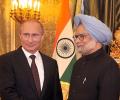
The 13-page joint statement issued after Prime Minister Manmohan Singh's annual summit with Russian President Vladimir Putin shows the breadth and depth of relations between the two countries and the trust factor that has been constant element behind it.

Immediate NSG membership will not help India realise its nuclear ambitions any faster. It could have easily left the process take its own course, instead of running a high-stakes campaign to get in, says B S Raghavan.

'If the dimensions of the strategic partnership worked out by India and the US seem like a grand alliance targeted at you-know-who, China had better realise that it has fathered it,' says B S Raghavan, a long time observer of China.

'India-US defence pacts are seen by many analysts as a subtle move to jointly contain China's growing militarism, especially in the strategic Indian Ocean Region.'

'Today the Chinese think they can slap India, and there will be no consequences.' 'They must be made to feel the consequences through any and all means,' says Rajeev Srinivasan.

Our large military requirements make for an enormous buyer's leverage, which the defence ministry fritters away in piecemeal purchases

Secretary Tillerson met with Foreign Secretary Jaishankar on Friday to discuss the US-India relationship and the agenda for Prime Minister Modi's meetings at the White House on June 26, a State Department spokesman said told PTI.

Right from conducting nuclear deterrence patrols in 2015 to its destructive space programme, from its back-tracking on economic commitments to its hardened positions on Sino-India border deal -- its approach with India spells Adversarial with a capital A, says Shehzad Poonawalla

PM Modi seems to be gradually ending India's strategic ambiguity
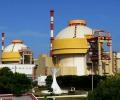
'Decisions on nuclear power have so far been taken by a small select group, primarily interested in profiteering from their actions, stating 'secrecy' as necessary from the national security point.' 'This argument is false, because we are dealing with the 'civilian' nuclear power sector, which is open even to the IAEA,' says Dr A Gopalakrishnan, former chairman of the Atomic Energy Regulatory Board.

'The cost of the Rafale contract will be substantially lower than being talked about.' 'If you throw away the price they demand, our coffers will soon become empty.' 'When it comes to spending the nation's money I am very careful and stingy.'

Moving ahead with their new mantra -- Chalein Saath Saath: Forward Together We Go -- Prime Minister Narendra Modi and United States President Barack Obama on Tuesday vowed to deepen cooperation in every sector for the benefit of global stability and people's livelihoods over the next ten years.

This is the joint statement issued by the ministry of external affairs on the visit of US President Barack Obama to India.
